May 15, 2026
GPS tracker battery life is a behaviour question, not a spec number
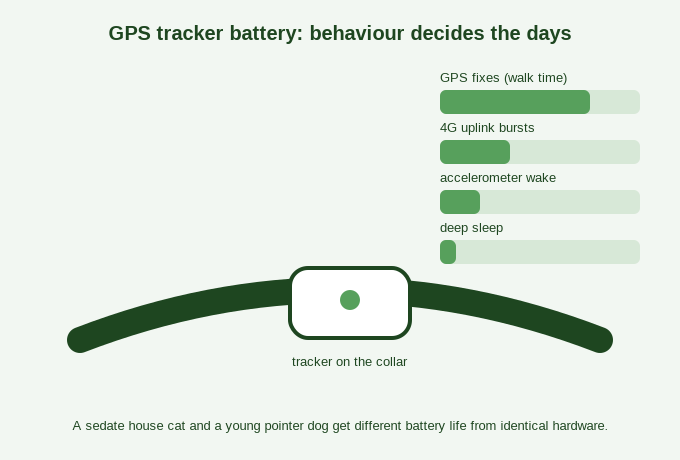
Every GPS tracker product page promises days of battery life. Every owner discovers the real number depends on what the dog does. Battery life in trackers is a behaviour question wearing a spec-sheet costume.
The three consumers
GPS fixes dominate: a continuous walk drains the budget fast, while idle fixes every few minutes barely register. Cellular uplink is bursty but heavy — each position upload, geofence event or firmware check wakes a radio that costs far more than the GPS itself. The motion sensor is the quiet hero: accelerometer-gated tracking (radio on only when the animal moves) is what separates week-long devices from day-long ones.
The behaviour matrix we design against
A house cat, a suburban family dog and a working pointer generate entirely different duty cycles. We design the firmware profile per segment: aggressive fix intervals and instant geofence for the working dog, long sleeps and periodic fixes for the cat. The same hardware ships in profiles — this is a firmware decision, not a hardware one.
What the spec sheet should honestly say
Not “14 days” but “X days at N fixes per day with M motion”. Trustworthy trackers publish the assumption matrix, and reviewers trust them more for it. We help clients define that matrix before the product page is written.
Charging as UX
Magnetic pogo pins, a dock that doubles as a nightstand charger, and a low-battery alert that arrives before the dog does — charging design is the difference between a tracker that stays on the collar and one that migrates to a drawer.